
You’ve probably tried a yoga class and left feeling calm but somehow disconnected from your body. Or finished a Pilates session feeling physically worked but mentally still wound up. Both are actually good practices — but on their own, each one leaves a gap the other fills.
Yoga and Pilates fusion is what happens when yogic breath and body awareness meet Pilates precision and core control. Your body starts communicating differently. Movement becomes intentional. Stillness becomes productive. And the nervous system , which most movement practices barely touch, actually gets to regulate.
This blog breaks down what this practice exactly is, what it does to your body and mind, and how you can take your first real step into it.
Table of Contents
What Is Yoga and Pilates Fusion?
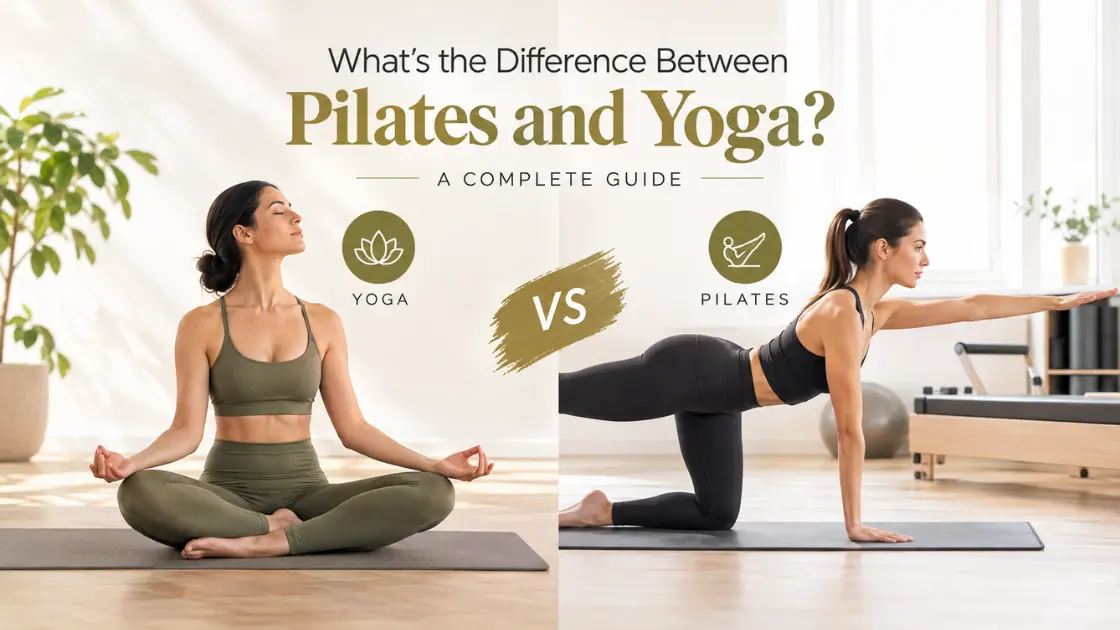
Yoga and Pilates fusion is a practice that intentionally combines the core principles of both disciplines into one session. The two work together, with breath cues from yoga layered into Pilates movements and the postural precision of Pilates brought into yoga flows.
At its root,
- Yoga trains attention through breath, held postures, and body awareness.
- Pilates trains control, specifically how the deep core, spine, and joints work together.
When these two come together in one practice, you stop just stretching or just strengthening and start building a body that moves with both stability and ease.
How Does a Yoga Pilates Workout Work?
A yoga Pilates workout builds on one simple idea: breath drives movement, and movement builds from the core out. Every exercise connects these two things deliberately. You’re not just stretching into a pose or grinding through reps. You’re learning to engage the right muscles while staying mentally present, which is something neither practice fully teaches on its own.
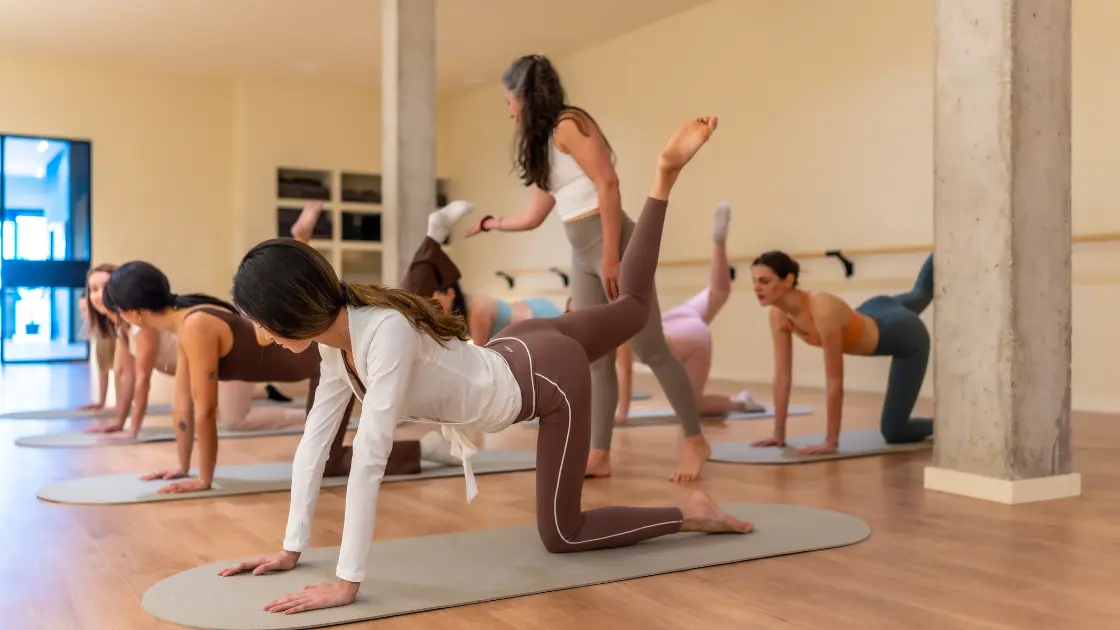
In practice, this looks like moving through familiar shapes — a plank, a bridge, a standing balance — but with layered intention behind each one. A Pilates bridge becomes a spinal articulation exercise rooted in yogic body awareness. A standing pose becomes a core stability drill – not just a stretch. The session typically opens with breath work to settle the nervous system, builds through a sequence that targets deep stabilizing muscles, then closes with restoration.
What’s the Benefit of Yoga and Pilates Workout
Combining yoga and Pilates doesn’t just give you two practices in one session. It creates a training effect that neither discipline produces alone.
Builds Functional Core Strength
Pilates targets the deep stabilizing muscles — transverse abdominis, pelvic floor, and spinal stabilizers — that standard exercise rarely reaches. Yoga teaches you to feel those muscles working through real movement patterns. The two together build a core that supports your spine in daily life, not just during a workout.
Improves Posture and Spinal Health
Research shows both Pilates and yoga improve posture and reduce pain in people with spinal conditions like hyperkyphosis. Pilates trains spinal articulation — each vertebra learning to move independently. Yoga actively lengthens the same structures. For people with desk-heavy lifestyles, this combination addresses chronic postural compression more directly than either practice alone.
Regulates the Nervous System
Breath-led movement directly influences the parasympathetic nervous system. Yoga’s breathing techniques combined with Pilates precision create a practice that builds physical demand while keeping the nervous system in a regulated state — something most conventional workouts don’t address at all.
Reduces Stress and Anxiety
Studies on both yoga and Pilates independently show meaningful reductions in stress and anxiety among regular practitioners. Fusion practice compounds this — the focused attention required during movement leaves little room for mental noise, and the breath work actively interrupts stress patterns stored in the body.
Increases Flexibility
Pilates improves strength, balance, flexibility, posture, and functional mobility while remaining joint-friendly and low impact. Yoga works the same range of motion actively through held poses and transitions. Together they produce flexibility that’s supported by strength — not the temporary kind that fades when you stop stretching.
Deepens Mind-Body Connection
The defining quality of an authentic fusion format is an emphasis on nonjudgmental awareness and mindfulness. That quality of attention — to breath, alignment, and how each body part affects another — builds gradually across sessions and eventually shifts how you move and carry yourself outside the studio too.
Popular Yoga and Pilates Exercises You Can Try
These five essential Pilates exercises are a good starting point — each one shows exactly how fusion practice layers Pilates precision onto yoga movement, or brings yogic breath into a Pilates shape.
Pilates Hundred with Yogic Breath
Lie on your back, lift your legs to 45 degrees, curl your head and shoulders off the mat, and pump your arms for 100 counts — inhaling for five, exhaling for five.
This breath pattern trains deep abdominal engagement and breath control at the same time.
Warrior III with Core Engagement
Hinge forward at the hips while lifting one leg behind you until your body forms a straight line from head to heel.
Draw the lower belly inward to stabilize the spine and you turn a balance pose into a full-body strength exercise.
Cat-Cow with Pelvic Floor Activation
Move through Cat-Cow one vertebra at a time, gently lifting the pelvic floor on each exhale.
This brings Pilates precision into what most people treat as a passive warm-up.
Pilates Roll-Up into Forward Fold
Use your deep abdominals to roll up from lying flat to sitting, then fold forward over your legs.
It builds spinal control and active hamstring lengthening in a single movement.
Bridge Pose with Spinal Articulation
Instead of lifting into Bridge and holding, peel your spine off the mat one vertebra at a time and roll it back down with control.
This builds glute strength while restoring mobility through each segment of the spine.
Is Yoga and Pilates Fusion Good for Beginners?
Yes, and in many ways it’s a better starting point than either practice alone.
Beginners often struggle with yoga because the breath-body connection feels abstract at first. And Pilates on its own can feel overly technical without the body awareness to back it up. Fusion builds both simultaneously. You’re not learning two separate systems — you’re learning one integrated approach from the start.
Fusion practice tends to work especially well for:
- Those recovering from burnout or chronic stress
- Anyone dealing with lower back pain or postural tension from desk work
- People who’ve tried yoga or Pilates separately and felt something was missing
- Those looking for a practice that addresses the mind as much as the body
Not sure which style of yoga speaks to you yet? Exploring different types of yoga and their benefits can help you understand where fusion fits into the broader picture.
How to Get Started?
Understanding how to start doing Pilates gives you the core awareness and breath control that fusion practice builds on. Once you have that, layering in yogic movement and mindfulness becomes intuitive rather than overwhelming.
You can look for a class that treats fusion as one connected practice — not yoga for 30 minutes followed by Pilates for 30 minutes. The integration of breath, movement, and body awareness is what makes fusion different, and a good instructor will guide all three together throughout the session.
That guidance matters more than most people expect. A trained instructor watches how you breathe, how you hold tension, and where your body compensates. They shape the session around what your body actually needs that day — something no app or video can replicate.
If you’re in Auburn, CA, and looking for a space that takes movement and healing seriously, Insumataq Studio offers yoga, somatic movement, breathwork, and wellness classes designed to work on the body and mind together.
Explore upcoming holistic wellness events happening at the studio. Or if you’re ready to get started, book a wellness class in Auburn, CA today — your first class is free.
Frequently Asked Questions (FAQs)
Most instructors recommend 2-3 sessions per week for noticeable changes in strength, flexibility, and body awareness. Consistency matters more than frequency.
Yes. The practice directly targets the deep spinal stabilizers and hip flexors that contribute to most chronic back pain.
A yoga mat is the only essential. Some classes use props like blocks or straps, but a good instructor will always offer alternatives.
No. Fusion adds Pilates principles — deep core engagement, spinal articulation, and precise muscle activation — which changes both the physical demand and the body awareness required.
In most cases yes, with modifications. Always inform your instructor about any injury before class so they can adjust movements accordingly.