
What Is a Sun Salutation?
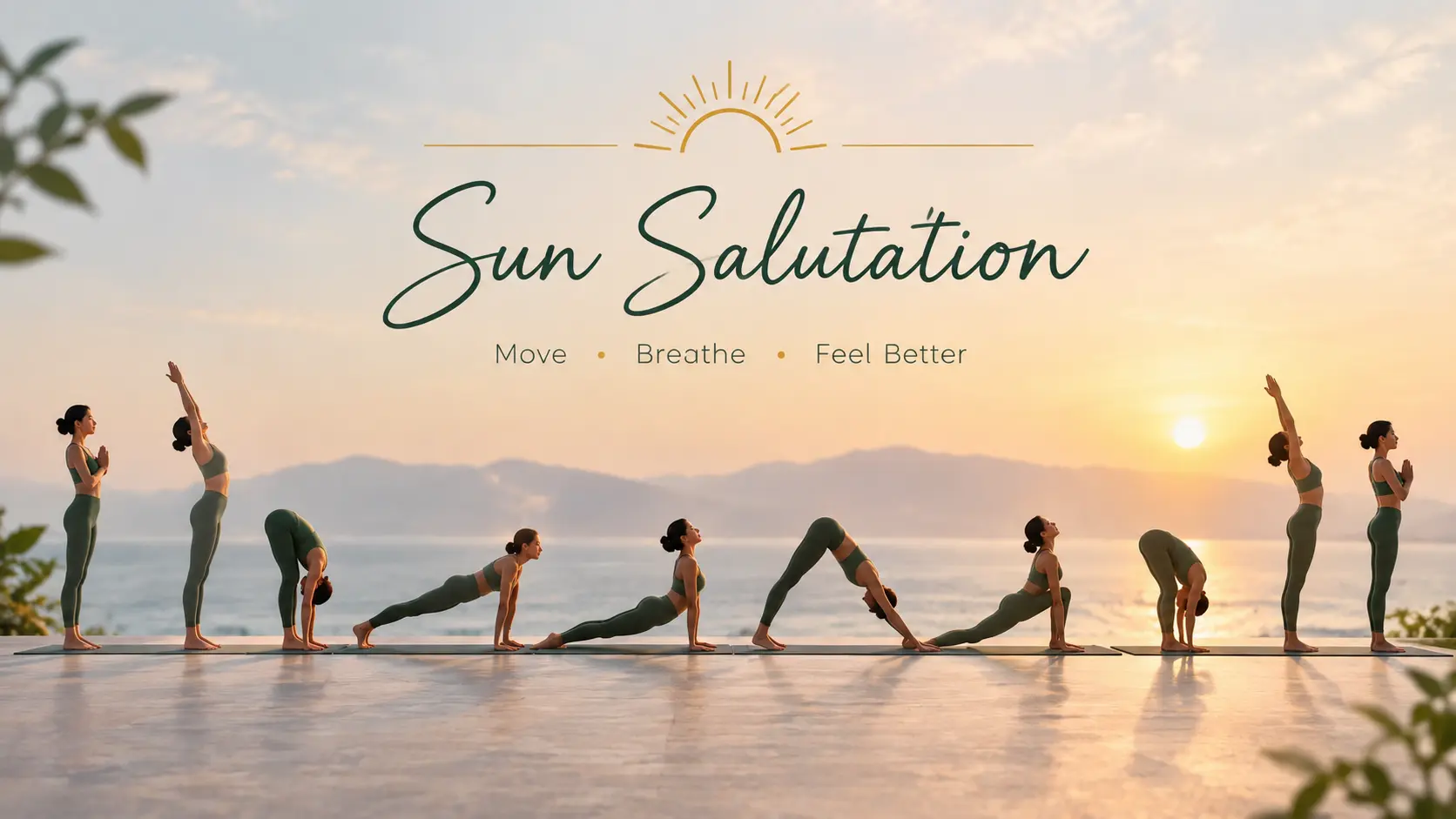
A sun salutation is a sequence of yoga poses that’s performed in a continuous flow, with each movement synchronized to either an inhale or an exhale. Rooted in ancient tradition, the practice is originally performed at sunrise as a gesture of gratitude toward the sun. Today it serves two purposes equally well – as an opening sequence before a longer yoga session or as a complete practice on its own that builds strength, flexibility, and mental focus.
What makes it distinct is how the poses connect. Each transition flows directly into the next, with every movement tied to a specific breath. That structure turns the sequence into something closer to moving meditation – the body stays active while the mind stays present. It has been practiced this way for thousands of years and remains central to styles – like Hatha yoga, Ashtanga, and Vinyasa for that exact reason.
Benefits of Sun Salutation
The benefits of sun salutation extend well beyond a physical workout. Each round works the muscles, stimulates circulation, regulates the breath, and brings the mind into focus – all at once, in under five minutes.
Here is what regular practice actually does for the body and mind.
Improved Flexibility – Each pose stretches a different muscle group, which helps build real flexibility across the entire body over time.
Muscle Strength – As it targets the core, legs, arms, and back at the same time, the practice builds endurance and muscle tone without any equipment needed.
Enhanced Circulation – The rhythmic combination of movement and breath increases blood flow and improves how well oxygen moves through the body.
Better Posture – The sequence strengthens the muscles that support the spine and gradually trains the body to hold proper alignment.
Higher Energy Levels – Sun salutations stimulate the body’s energy channels, and most people feel noticeably more alert and awake almost instantly.
Different Types of Sun Salutations
While the core principle – linking breath with movement through a flowing sequence – stays consistent, the poses, pace, and intention vary across different yoga traditions.
Each variation serves a slightly different purpose, which is why understanding the differences helps you choose the one that fits your practice and your goals.
Surya Namaskar A (Sun Salutation A)
Surya Namaskar A is the starting warm-up sequence of Ashtanga Vinyasa yoga. It consists of seven poses connected through ten smooth transitions. This makes it the most accessible version of sun salutation for anyone new to the practice.
How to do it
- Start standing tall in Mountain Pose
- Inhale, raise both arms overhead
- Exhale, fold forward toward the floor
- Step back into a plank, lower down through Chaturanga
- Inhale into Upward-Facing Dog
- Exhale, lift hips up and back into Downward-Facing Dog
- Step or jump feet forward, rise back up to standing
Surya Namaskar B (Sun Salutation B)
Surya Namaskar B builds directly on Sun Salutation A, adding Chair Pose and Warrior I to create a longer, more physically demanding sequence. It consists of 17 movements per round and generates significantly more heat than the A variation.
How to do it
- Start in Mountain Pose, bend knees into Chair Pose
- Exhale, fold forward, and step back through Chaturanga
- Inhale into Upward-Facing Dog, exhale into Downward-Facing Dog
- Step right foot forward into Warrior I, arms overhead
- Flow back to Downward-Facing Dog, repeat Warrior I on the left
- Step forward, rise into Chair Pose, and return to Mountain Pose
Classical Hatha Sun Salutation
The Classical Hatha Sun Salutation is an older, slower version of the sequence rooted in traditional Hatha yoga. Unlike the Ashtanga variations, it moves more deliberately and is sometimes practiced alongside mantras – making it both a physical and meditative experience.
How to do it
- Begin in Prayer Pose, hands at the heart
- Inhale, sweep arms up and back
- Exhale, fold forward, and step the right leg back into Equestrian Pose
- Lower knees, chest, and chin to the floor
- Inhale into Cobra Pose, exhale into Downward-Facing Dog
- Step right foot forward into Equestrian Pose, and bring left foot to meet it
- Rise back up, return to Prayer Pose
- Repeat on the left side to complete one full round
Moon Salutation (Chandra Namaskar)
The Moon Salutation is a cooling counterpart to the sun salutation, designed to calm rather than energize. It moves side to side rather than front to back and is typically practiced in the evening to settle the nervous system and encourage stillness.
How to do it
- Begin in Mountain Pose, hands at heart
- Inhale arms overhead, exhale into a side stretch both ways
- Step feet wide, flow through Goddess Pose and Star Pose
- Move through Triangle, Pyramid, and Low Lunge on the right side
- Transition through Side Lunge into Garland Pose at center
- Mirror the full sequence on the left side
- Return to standing, hands back at heart
If you’re still exploring which style of yoga suits you best, understanding different types of yoga and their benefits can help you see where sun salutations fit within the bigger picture.
Sun Salutation Sequence: Step-by-Step Breakdown for Beginners
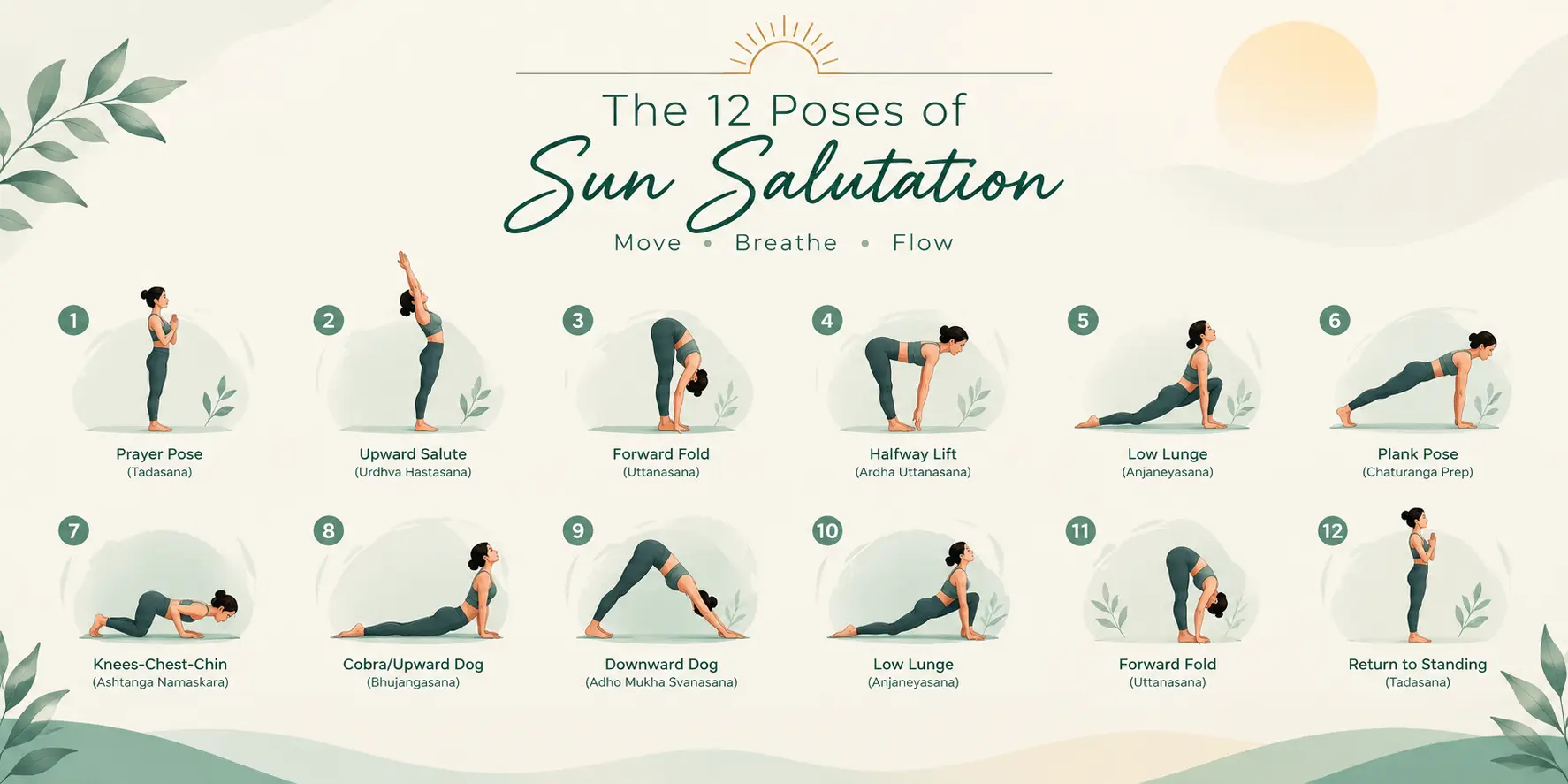
The classical sun salutation is the most foundational version of the sequence and the best starting point before exploring other variations. It follows 12 steps, each tied to either an inhale or an exhale – your breath leads, and your body follows.
🧘 The 12 Poses of Sun Salutation
- Prayer Pose
- Upward Salute
- Forward Fold
- Halfway Lift
- Low Lunge
- Plank Pose
- Knees-Chest-Chin
- Cobra/Upward Dog
- Downward Dog
- Low Lunge (opposite leg)
- Forward Fold
- Return to standing
Beginners can start with 2 to 3 rounds and build gradually as the sun salutation sequence becomes more familiar and the breath starts to feel natural within the flow.
Sun Salutation for Beginners: What to Expect & Best Time to Do
Most beginners move through their first sun salutation feeling like they’re two steps behind – reaching for the next pose before they’ve fully settled into the current one. But this isn’t a problem. It’s exactly how the practice starts for almost everyone.
The sun salutation only begins to feel fluid once the body has learned the order, and that usually happens within a few sessions – not the first one.
What helps most in the beginning is slowing down. Focus on the breath first and let the movement follow. A few things worth knowing before you start:
- You don’t need to be flexible – the practice builds flexibility over time
- Modify freely – bent knees, lowered knees, Cobra instead of Upward Dog
- Slow down if the breath feels rushed – breath timing matters more than pace
- Start with 2 to 3 rounds per session and build gradually
Best Time to Practice Sun Salutation
Early morning, ideally before eating, is the most effective time. The body warms up quickly after sleep, circulation improves, and the mind tends to be clearer before the day’s demands set in. Traditionally, the practice was performed facing the rising sun – a ritual of gratitude as much as movement.
- Morning – Before eating, facing the rising sun. Builds heat, improves circulation, and sets a focused tone for the day.
- Midday – A few rounds release tension from long hours of sitting and restore focus for the second half of the day.
- Evening – Keep the pace slow and gentle. The goal shifts from building heat to releasing what the body has held throughout the day.
Conclusion
Sun salutation is one of the most complete practices in yoga and one of the most accessible. Twelve poses, a few minutes, and a consistent breath pattern – that’s all it takes to work the entire body, reset the nervous system, and bring the mind into focus. Whether you practice two rounds in the morning before work or a longer session on weekends, the benefits compound the longer you stay consistent.
The best way to understand what a sun salutation is and what it actually feels like is to experience them in person, with guidance that meets you where you are.
If you’re in the Auburn, CA, area, Insumataq Studio offers yoga and wellness classes rooted in real healing – not just movement. Explore upcoming holistic wellness events and find a session that feels right for where you are right now. Or if you’re ready to get on the mat, book a wellness class near Auburn, CA today – your first class is free.
Looking for yoga and meditation centers near Auburn? Insumataq Studio is a good place to start.