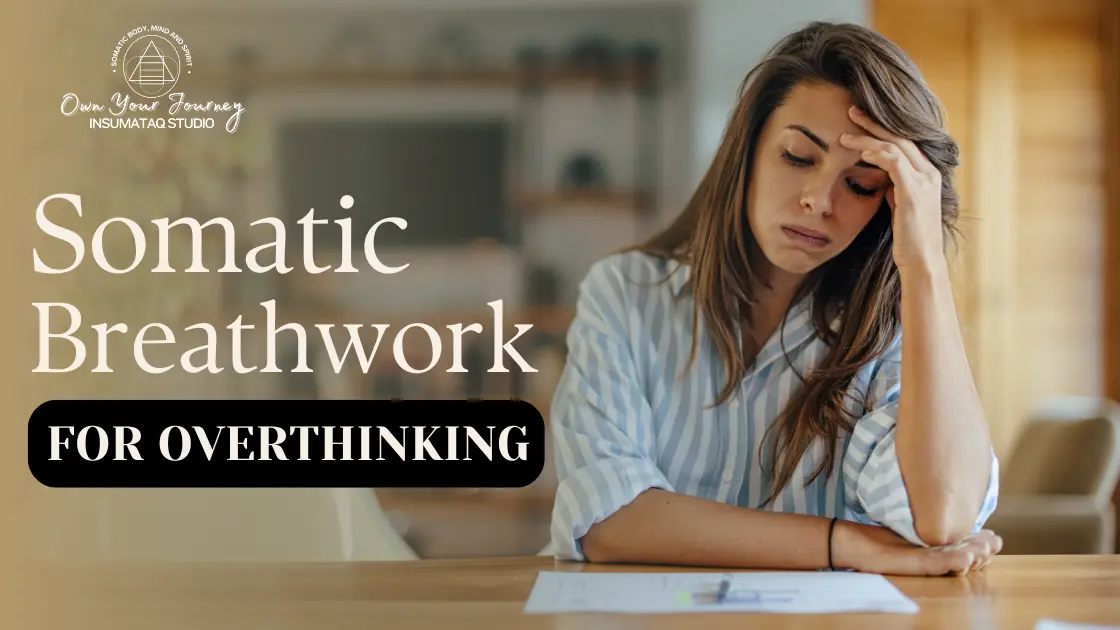

Overthinking rarely responds to willpower. Telling yourself just to relax or “just stop thinking about it” tends to make the loop worse – not better. This is simply because overthinking isn’t purely a mental habit. It’s closely tied to the state of your nervous system.
When your body is in a stressed or activated state, your mind tends to follow. It starts replying with worries and worst-case scenarios even after the trigger has passed. This is where somatic breathwork for overthinking becomes useful. Rather than trying to think your way out of a racing mind, somatic breathwork uses specific breathing patterns to work directly with the nervous system. This helps the body shift out of that activated state so the mind has room to settle on its own.
If you’re wondering how to deal with overthinking , understanding what is happening in your body can be an important first step.
This blog breaks down how somatic breathwork works, why it targets overthinking more effectively than mental techniques alone, and how to start practicing it, including what to do in the moment during an anxiety attack.
Table of Contents
What Happens in Your Body When You Overthink
Overthinking doesn’t just affect your mind. It changes what’s happening in your body as well. When you understand this connection, it’s easier to see how working with your breath can actually settle a racing mind.
Your nervous system tends to swing between two states: one geared toward alertness and stress (fight-or-flight mode) and another geared toward calm and recovery (rest mode). When you’re stuck overthinking, your body is usually parked in that first state, even when nothing around you is actually wrong. Your mind picks up on that signal and keeps searching for something to justify it. This is where somatic breathwork plays a key role by using conscious breathing techniques to influence the nervous system.
Beyond calming the body, this same process often uncovers something deeper. Stress and unresolved emotion tend to settle in the body just as much as the mind. This is the reason why breathwork for releasing emotions has become such a valuable part of somatic practice – giving those feelings a physical way to move and resolve instead of staying stuck beneath the surface.
How Somatic Breathwork Helps Calm an Overactive Mind
Breath is one of the few tools that can actually shift which state your body is in. Slow and intentional breathing sends a physical signal of safety to your nervous system. The moment your brain receives that signal, your thoughts tend to settle right along with it. The best part is it works differently than distracting yourself or trying to think your way calm.
These deep breathing exercises for emotional regulation can help create a pause between the physical stress response and the thoughts that follow it.
Stress and emotion that never got fully processed tend to stay stored in the body, and somatic techniques are built specifically to help release that stored tension – not just quiet the mind for a few minutes. In practice, this usually shows up as:
- A calmer nervous system, as your body eases out of alert mode and into something more regulated
- Emotional release, as tension that’s been sitting in the body finally has a way to move through and out
- Mental clarity, once your body stops sending stress signals that keep your mind on high alert
- A felt sense of lightness, which is why so many people say they feel emotionally lighter afterward, not just calmer
This is really what makes somatic breathwork for overthinking work so well. More often than not, overthinking isn’t random; it’s your mind trying to process something your body hasn’t fully let go of yet. Somatic breathwork meets that part of the pattern directly, which is usually the part that thinking alone can never quite reach.
Breathwork vs. Meditation: Which Brings Faster Calm
If you’ve tried meditation for overthinking and it never quite worked, you’re not alone. Sitting still and trying to “clear your mind” is hard when your thoughts are already racing. For someone already caught in a spiral, Meditation or mindfulness exercises for overthinking often ask for stillness that isn’t there already. Somatic breathwork for overthinking works differently.
Breathwork doesn’t ask you to observe your thoughts without getting pulled into them. It works through the body first, using your breath to shift your nervous system out of stress mode. Your mind settles as a result of that shift, not because you’re forcing it to.
| Somatic Breathwork | Meditation | |
|---|---|---|
| Main focus | Regulating the nervous system through breath | Observing thoughts without engaging them |
| Best for | Quickly calms an already-activated mind or body | Building long-term awareness and mental stillness |
| How it works | Uses breath patterns to shift the body out of stress mode | Trains attention to notice thoughts and let them pass |
| Benefit | Faster relief when the mind feels too active to sit still | Greater self-awareness and clarity over time |
| Physical Involvement | Active, breath-led, body-centered | Minimal |
Neither approach is better than the other. They simply work best in different situations. A lot of people get the most value from using both. Starting with a short breathwork session or a tension release meditation that incorporates breath can calm your body enough that meditation stops feeling like a struggle and becomes something you can actually settle into.
Four Ways Somatic Breathwork Helps With Overthinking
Somatic breathwork does more than help you feel calmer for a few minutes. It creates specific physical changes in the body, and each one plays a part in interrupting the overthinking cycle rather than just papering over it for a while. Here’s how somatic breathwork actually helps keep your mind calm from overthinking.
Regulates the nervous system
Slow, intentional breathing moves your body out of a stressed, alert state and into a calmer one. Your mind takes its cues from that internal state. That means once it shifts from that state, overthinking loses much of the fuel that was keeping it going.
Releases stored stress and tension
Unprocessed stress doesn’t just fade on its own; it settles into the body and stays there. Somatic breathwork gives that tension an outlet, which is often why people feel physically lighter after a session – not only quieter in the head.
Reduces anxiety and mental chatter
Once the nervous system calms and that built-up tension has somewhere to go, racing thoughts naturally lose momentum. You’re not fighting your mind into silence; you’re simply removing what was keeping it so loud.
Improves emotional regulation
A lot of overthinking traces back to emotions that were never fully felt or resolved. Working through the body gives those emotions a real chance to move, instead of resurfacing again and again as intrusive thoughts. With regular practice, this makes it easier to meet stress with steadiness rather than getting swept up in it.
Each of these plays a part in why somatic breathwork for overthinking gets results that pure mental effort rarely can. It addresses what’s actually driving the pattern, not just the thoughts it produces.
How to Keep Your Mind Calm from Overthinking Using Breathwork?
When overthinking takes hold, the fastest way back to calm is shifting your breath deliberately, rather than trying to think your way out of it. The moment you slow it down, your attention has somewhere else to go. Your nervous system picks up on that shift, taking it as a cue to ease off the stress response instead of staying locked into it.
Grounding exercises for overthinking can also give your attention something physical to focus on when your thoughts feel difficult to slow down.
Somatic breathwork gives you a few different ways to make that happen, and the right one often depends on what kind of overthinking you’re dealing with:
- Diaphragmatic breathing – slow, deep belly breaths to trigger the body’s natural relaxation response. It’s simple enough to use in the middle of a task, which makes it a practical option for everyday overthinking rather than a full-blown spiral.
- Box breathing – follows an even pattern of inhale, hold, exhale, and hold. The structure gives your mind something concrete to follow, so it works well when overthinking feels urgent or hard to break.
- Resonance breathing – slows your breath to a specific, steady rhythm linked to nervous system balance. Since it works gradually rather than as a quick fix, it’s better suited to the kind of low-grade overthinking that lingers in the background for hours.
- 4-7-8 breathing – involves inhaling for four counts, holding for seven, and exhaling for eight. Many people reach for this one specifically at night, when overthinking tends to replay the day just as they’re trying to fall asleep.
Ultimately, you don’t need to try all four to get something out of this. Pick one that matches the moment: box breathing for a spike of urgent overthinking, 4-7-8 if it’s keeping you up at night, and use it the next time your mind starts running.
How To Start Your Somatic Breathwork Journey
Learning about these techniques is the easier part. What’s harder to predict is the right way to perform them and what happens once the breath actually starts working – unexpected emotions, physical sensations, even memories can surface, and that’s not something most people are prepared to navigate on their own. This becomes especially true if you’re trying to figure out how to breathe during an anxiety attack in the moment, without any guidance on hand.
For people looking into overthinking therapy, somatic breathwork can be considered alongside other forms of professional support rather than as a replacement for therapy.
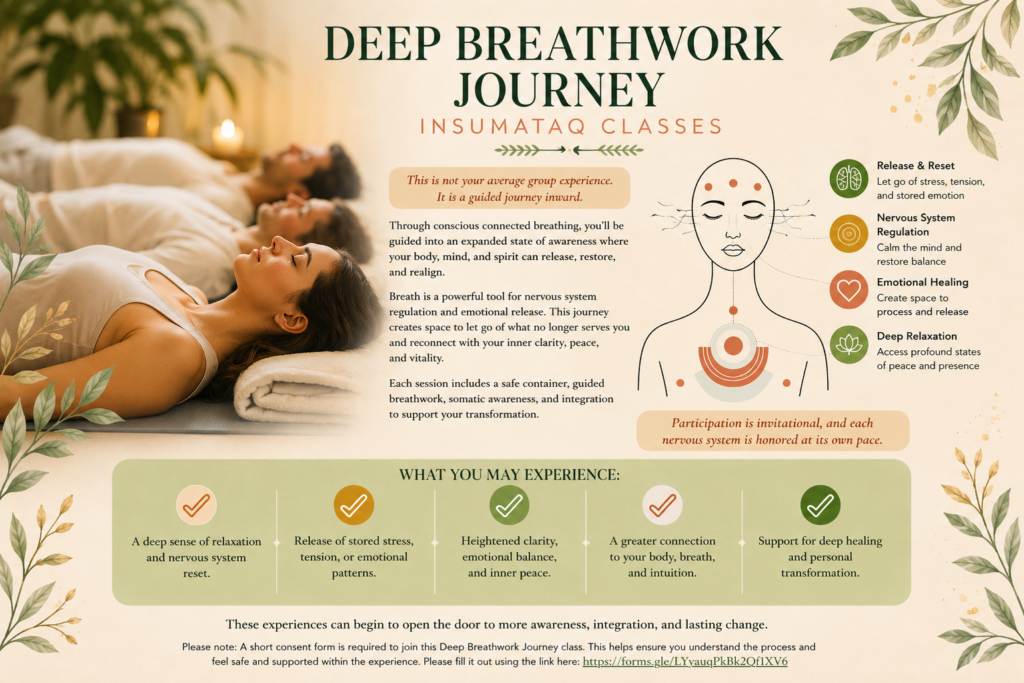
This is why somatic breathwork tends to work best and feel safest with professional support rather than solo practice. If you want to try it in a guided setting, Insumataq Studio in Auburn offers Somatic Breathwork class built to help regulate your nervous system, work through what your body has been holding, and finally quiet an overactive mind, with real guidance the whole way.
Conclusion
Overthinking doesn’t get fixed by thinking your way through it, no matter how hard you try. Your anxious mind just follows your body’s lead, and when your nervous system is stuck in a stressed state, willpower isn’t enough to shut it off. Somatic breathwork takes a different approach when it comes to calming the mind by working with the body first. It meets the problem where it actually starts, in the body, using breath to release tension, calm the nervous system, and finally give your mind some room to slow down.
Whether you’re just beginning to explore somatic breathwork for overthinking or you’ve been looking for something that reaches deeper than meditation alone, it’s a practice worth experiencing with real guidance behind it. Insumataq Studio in Auburn offers Somatic Breathwork, Somatic Therapy, and Somatic Yoga for beginners through experienced practitioners. Come as you are, and let these classes help you set down what your body’s been carrying, so you can find your way back to a calmer, clearer mind.
Frequently Asked Questions (FAQs)
Some people feel a shift in a single session, while others notice deeper changes after a few weeks of regular practice. It depends on the individual and how consistently it's practiced.
Most people can practice it safely, but those who are pregnant or have uncontrolled high blood pressure, epilepsy, or serious cardiovascular conditions should consult a healthcare provider first.
Slow breathing, grounding exercises, and mindfulness can help calm the nervous system and reduce repetitive thoughts. Somatic breathwork can also help create a greater sense of calm and mental clarity.
It can be a valuable complement to therapy, but it isn't a replacement, especially for anxiety or overthinking tied to deeper mental health concerns.
Many people benefit from a short daily practice at home, paired with occasional guided sessions for deeper release and support.
No prior experience is needed. Beginners are welcome, and sessions are typically designed to meet you wherever you're starting from.